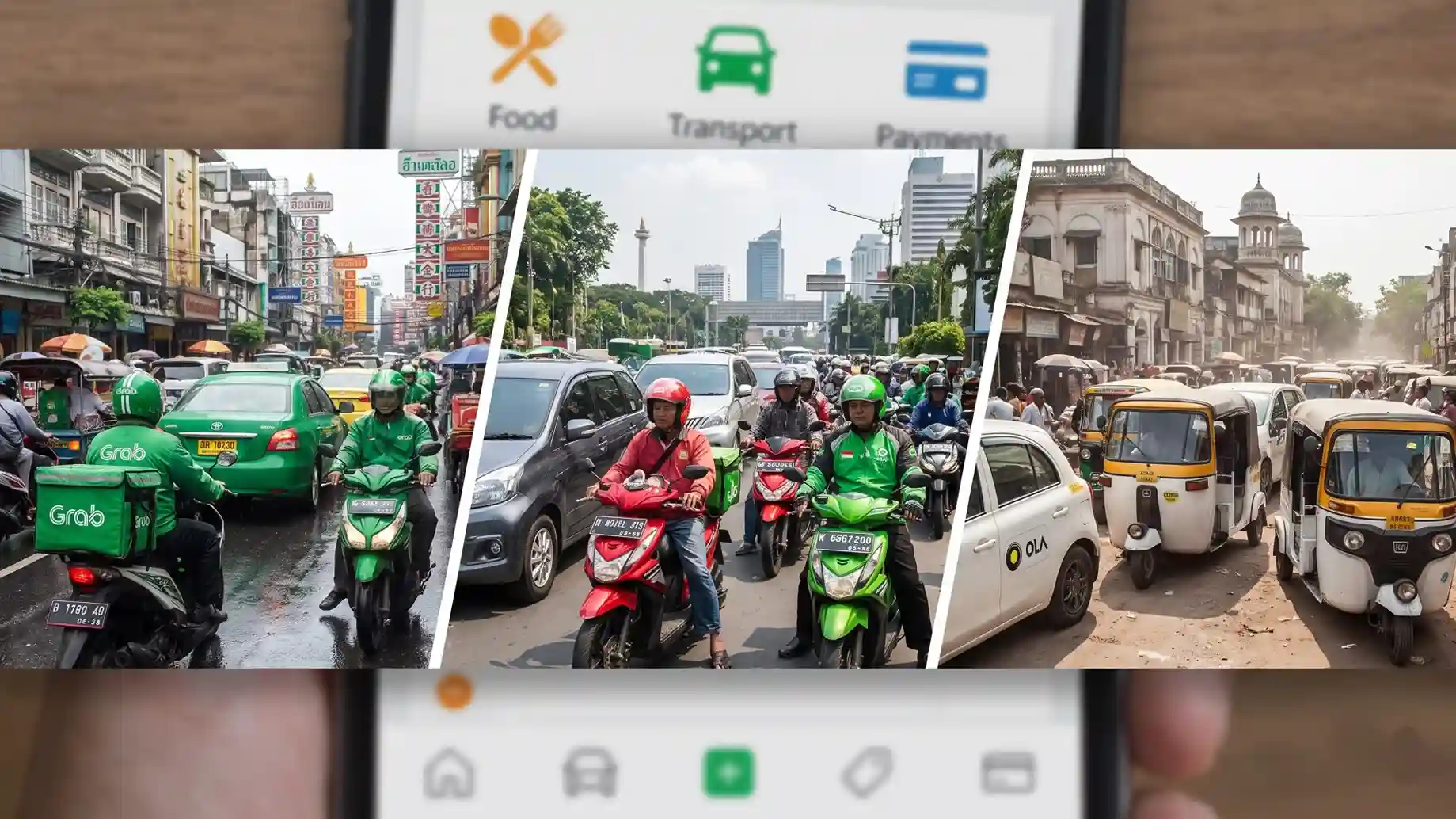
One of these three apps might soon buy another, and that alone shows how big this fight has gotten. Talks between two of them reportedly reached a deal worth around seven billion dollars in late 2025, for a merger that still has not fully closed.
Grab vs Gojek vs Ola is not just a fun comparison for tech blogs. It is one of the biggest business stories in Asia right now. Each of these three apps started with one simple job, getting someone from point A to point B, and each one grew into something much bigger than that.
What Makes an App a True Super App?
A regular app does one thing well, while a true super app does several things well that too all inside the same login.
Rides, food delivery, payments, and sometimes even shopping, all bundled into one place, is a formula Asian super apps figured out years before most of the world caught on. The idea behind it is simple. Once someone trusts an app enough to book a ride, they will often trust it enough to order food or pay a bill through that same app too.
Grab, the Regional Giant Built for Scale
Grab started in Malaysia back in 2012 as a simple taxi-booking app, built to compete directly with Uber in a market Uber had not yet fully claimed. Today, it operates across eight countries in Southeast Asia and holds around 70% of the region's ride-hailing market, which is a massive lead for any single company to hold across so many countries at once.
The turning point came in 2016, when Grab added food delivery through
GrabFood after realizing its driver network could deliver meals during the slow hours between rides instead of sitting idle. That single move reportedly boosted daily active users by 80%. From there, Grab kept adding services one at a time rather than all at once, GrabMart for convenience store orders, GrabExpress for parcels, and GrabPay for payments. Interestingly, Malaysia has now overtaken both Singapore and Indonesia as Grab's biggest market by revenue, even though Grab started out as a Malaysian company in the first place.
The lesson here is fairly simple. Grab did not add services randomly, it used every new service to serve the same drivers and the same customers it already had.
Gojek, Indonesia's Deeply Rooted Ecosystem
Gojek took a different path. Instead of spreading across many countries, it went deep into just one, Indonesia, and built something incredibly sticky there.
Gojek, now part of a larger group called GoTo, holds around 60% of Indonesia's ride-hailing market. Its real strength lies in the ecosystem connecting Gojek rides, GoFood delivery, GoPay payments, and Tokopedia shopping into one continuous loop, so a rider on Gojek is often also a GoPay user and a Tokopedia shopper, without ever leaving that same broader system.
Here is where things get interesting. In late 2025, merger talks between Grab and GoTo picked up serious speed, reportedly valuing a deal at close to seven billion dollars. As of early 2026, the deal has run into complications over a state backed shareholder's stake, but the fact that talks got this far shows just how much scale matters in this business. Sometimes the smartest move is not competing head to head with a rival for another decade, it is joining forces with one instead.
The lesson from Gojek is a little different than Grab's. It proved that going deep in one market can be just as powerful as spreading wide across many.
Ola, India's Homegrown Pioneer Now in Transition
Ola tells a more complicated story. For years, it was India's dominant ride-hailing app, the clear homegrown answer to Uber, and it grew fast on the strength of that early lead.
That picture has shifted quite a bit recently. Recent estimates put Uber ahead in India's cab segment with around 50% share, Ola at roughly 34%, and a fast growing competitor called Rapido picking up the rest. In bike taxi and auto rickshaw bookings, the numbers look even tougher for Ola, since Rapido has overtaken it in several major cities entirely. At the same time, Ola's founder has shifted much of his personal attention toward Ola Electric, now India's top electric scooter maker, and Krutrim, an Indian artificial intelligence company he also leads.
Ola is not disappearing, and it remains a major player in Indian mobility. But it looks less like a classic all in one super app right now, and more like a company spreading its bets across ride-hailing, electric vehicles, and artificial intelligence at the same time.
The lesson here matters too. Even a strong early leader has to keep innovating, or newer, more focused competitors will chip away at that lead piece by piece.
What Do These Three Super Apps Actually Have in Common?
Despite their different paths, all three started the exact same way, with one core service, rides, and let every other service come later, built on top of the same drivers and the same trust they had already earned from customers.
That is really the blueprint behind every successful multi-service ride-hailing app in this region.
Ride-hailing super apps are not built by launching ten services on day one, they are built by nailing one service first, then expanding carefully into whatever naturally fits the network already in place.
What Does This Mean If You Are Building Your Own Platform?
If you are considering super app development for your own market, the pattern from Grab, Gojek, and Ola is worth studying closely, not copying blindly, since your market will never look exactly like theirs did.
Start with one strong core service, then use the same drivers, riders, and trust you already earned to add a second service once the first one is genuinely working well, not before. Grow deep into markets you understand, the way Gojek did, or grow wide across new ones, the way Grab did, but be intentional about which path actually fits your resources and your team.
How UnicoTaxi Fits Into This
UnicoTaxi is built around this exact same idea, one strong core platform that can grow into a true multi service business, without needing the years of development Grab and Gojek once needed.
It comes with a passenger app, a driver app, an admin panel, and a dispatcher panel, all under your own brand from day one. As your business grows, delivery, pooling, and other services can be added on top of that same foundation, using the same drivers and the same customer trust you already have, the exact pattern behind every super app in this comparison.
Final Thoughts
Grab vs Gojek vs Ola shows three different roads to the same destination, becoming an essential part of daily life for millions of people. Grab scaled wide, Gojek went deep, and Ola diversified into new industries entirely, and none of these paths happened by accident.
Ready to build your own version of this success story? Talk to UnicoTaxi for a free consultation and live demo.
Contact Us
Frequently Asked Questions
1. Which of the three, Grab, Gojek, or Ola, is the biggest super app?
By regional reach, Grab is the largest, operating across eight Southeast Asian countries. Gojek is strongest within Indonesia specifically, while Ola remains a major player in India but faces growing competition at home.
2. Is a Gojek clone app a realistic way to launch a similar business?
Yes. A well built, white-label platform can replicate the core structure behind Gojek's success, ride-hailing, delivery, and payments in one app, without needing years to build it from scratch or the deep pockets these companies started with.
3. Why did Grab and Gojek take such different growth strategies?
Grab prioritized regional scale across multiple countries early on, while Gojek focused on building a deep, sticky ecosystem within Indonesia alone, and both strategies worked, just in very different ways.
4. Is Ola still considered a super app today?
Ola remains a major ride-hailing player in India, but its parent company has increasingly focused on electric vehicles and artificial intelligence, which makes it look somewhat different from the classic all in one super app model that Grab and Gojek follow.
5. How long does it take to build a multi-service ride-hailing app from scratch?
Building entirely from scratch, the way these companies originally did can actually take years, while a ready made, white-label platform can reduce that timeline down to weeks instead.